7 Minute Read

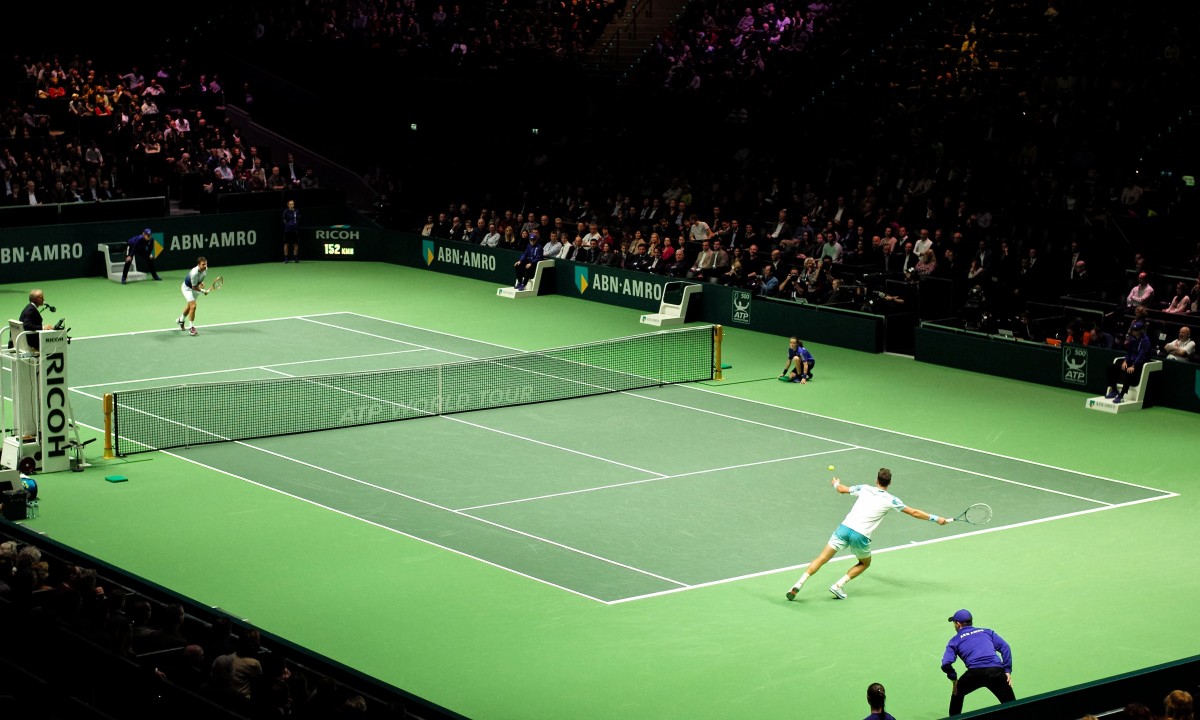
Tennis courts are built to precise specifications that ensure consistent play at every level, from recreational facilities to professional tournaments. According to the International Tennis Federation (ITF), a standard tennis court measures 78 feet (23.77 meters) long, with widths of 27 feet for singles and 36 feet for doubles. Beyond court dimensions, proper lighting, visibility, glare control, and uniform illumination all contribute to player performance and safety.

Key Takeaways

  • Additional clearance beyond the playing lines is required to provide safe runoff space for players.
  • Proper tennis court lighting improves visibility, reduces shadows, and helps players track fast-moving balls.
  • Lighting uniformity and glare control are just as important as overall brightness for player comfort and safety.
  • LED sports lighting delivers better performance, lower maintenance costs, and greater energy efficiency than traditional HID lighting systems.
  • Lighting requirements vary depending on whether the court is used for recreational play, club competition, or tournament-level events.

What Are the Standard Dimensions of a Tennis Court?

Most facilities require additional surrounding space for player runoff, fencing, lighting poles, walkways, and maintenance access when planning the overall court layout.

Tennis Court Measurement

Dimensions

Court Length

78 ft (23.77 m)

Singles Court Width

27 ft (8.23 m)

Doubles Court Width

36 ft (10.97 m)

Net Height at Center

3 ft (0.914 m)

Net Height at Posts

3.5 ft (1.07 m)

These standardized dimensions create a consistent playing experience across recreational, collegiate, and professional facilities.

Singles vs. Doubles Court Dimensions

The only dimensional difference between singles and doubles tennis is the court width. Singles matches use the inner sidelines, while doubles matches include the 4.5-foot doubles alleys on each side, increasing the total width from 27 feet to 36 feet. Court length and net height remain the same for both formats.

Total Facility Footprint & Clear Space Requirements

While a standard doubles tennis court measures 78 feet by 36 feet, the overall facility requires additional space beyond the playing surface. Most recreational and club courts are designed with an overall footprint of approximately 120 feet by 60 feet to provide runoff space, fencing, lighting poles, walkways, and maintenance access. Planning for the complete site, not just the court dimensions, helps improve player safety, lighting performance, and long-term facility operation.

Key Areas of a Tennis Court

Every line and marking on a tennis court serves a specific purpose and helps define the playing area.

Baseline and Sidelines

The baseline forms the back boundary of the court, where players serve and often position themselves during rallies. The sidelines define the width of the playing area, with the inner sidelines used for singles matches and the outer sidelines including the doubles alleys for doubles play. Adequate runoff space beyond the baseline and sidelines helps improve player safety by allowing players to move freely during play.

Baseline

Service Boxes

The service lines and center service line form the service boxes. Every serve must land in the diagonally opposite service box to begin a point legally.

Service Boxes

Net and Center Mark

 The net divides the court into two equal halves and measures 3 feet high at the center and 3.5 feet high at the posts, in accordance with International Tennis Federation (ITF) standards. The center service line divides each side of the court into two service boxes, while the center mark identifies the correct serving position behind each baseline. Together, these court markings ensure accurate gameplay and proper serve placement. 

Center Service Line and Center Mark

Doubles Alley

Each doubles alley is 4.5 feet wide, expanding the court from 27 feet to 36 feet for doubles matches.

Doubles Alley-1

Why Tennis Court Lighting Is Just as Important as Court Size

A regulation-size tennis court still requires proper lighting to support visibility, player safety, and consistent play. Modern LED lighting systems provide uniform illumination, reduce shadows and glare, improve ball visibility, and lower energy and maintenance costs compared to traditional HID lighting. When combined with proper court dimensions, professionally designed lighting creates a safer and more enjoyable playing experience.

How Does Tennis Court Lighting Improve Visibility?

Proper tennis court lighting helps players track the ball more accurately while improving safety and overall playability. Because tennis involves a small, fast-moving ball, lighting should provide uniform illumination, minimize shadows, and reduce glare across the entire court.

Well-designed LED lighting systems improve visibility by:

    • Delivering consistent illumination across the playing surface.
    • Reducing shadows that interfere with ball tracking.
    • Improving color rendering and contrast.
    • Providing instant-on performance with lower maintenance than HID lighting.

Professionally designed LED lighting improves visibility for players while creating a better experience for officials and spectators.

What Foot-Candle Levels Are Recommended for Tennis Courts?

The recommended foot-candle level depends on how the court is used. Recreational courts require less illumination than competitive or televised venues, but every installation should provide consistent lighting across the entire playing surface.

Court Type

Average Foot-Candles (fc)

Approximate Lux (lx)

Residential / Recreational

20–30

215–325

Parks & Community Courts

30–50

325–540

Club & High School Competition

50–75

540–810

Tournament Play

75–100+

810–1,075+

Professional Broadcast Courts

Varies

Varies

While achieving the appropriate brightness is important, simply increasing light output is not the goal. A well-designed system distributes light evenly, allowing players to see the ball clearly from every position on the court.

Lighting designers often evaluate both horizontal illumination on the playing surface and vertical illumination, which helps players track high serves, lobs, and overhead shots.

What Is Lighting Uniformity?

Lighting uniformity measures how evenly light is distributed across the tennis court. A court with high uniformity minimizes bright spots and dark areas, creating a more consistent playing environment. For most recreational and competitive tennis courts, lighting designers commonly target an average-to-minimum (Avg/Min) uniformity ratio between 1.5:1 and 2.0:1, depending on the level of play. Lower ratios indicate more evenly distributed light and fewer noticeable bright or dark areas across the court.

Uniform lighting helps players:

  • Track the ball from baseline to baseline.
  • Judge depth and ball trajectory more accurately.
  • Reduce eye strain during extended matches.

More fixtures alone do not guarantee better lighting—fixture placement, optics, mounting height, and aiming all influence uniformity.

For competitive facilities, lighting designers use photometric modeling to verify that illumination levels remain consistent throughout the entire playing area before installation begins.

Why Is Glare Control Important on Tennis Courts?

Glare occurs when excessive brightness interferes with a player's ability to see the ball clearly.

High serves, lobs, and overhead shots require players to look directly toward the lighting system. If fixtures produce excessive glare, players may temporarily lose sight of the ball, affecting both performance and safety.

Modern LED sports lighting minimizes glare through precision optics, optical shielding, fixture cutoff angles, and careful aiming. Many lighting designers also evaluate Unified Glare Rating (UGR) and fixture optics to reduce direct glare while maintaining consistent illumination across the court.

  • Precision beam optics that direct light onto the court instead of into players' eyes.
  • Shielding that reduces direct exposure to the light source.
  • Proper fixture aiming to control brightness and minimize spill light.
  • Strategic pole placement that keeps fixtures outside normal sightlines during play.

Reducing glare benefits more than just athletes. It also improves visibility for officials, coaches, and spectators while minimizing light trespass onto neighboring properties.

How Many Light Poles Does a Tennis Court Need?

Most tennis courts use between four and eight light poles, depending on the level of play, pole height, fixture output, and lighting performance goals.

There is no single layout that works for every facility. A lighting designer evaluates the court dimensions, target illumination levels, and surrounding site conditions before determining the most effective pole arrangement.

Typical Layout

Common Application

4 Poles

Recreational courts with taller poles and higher-output fixtures

6 Poles

Clubs, schools, and many municipal facilities

8 Poles

Competitive venues requiring exceptional uniformity and reduced glare

Pole height also affects light distribution and glare. Taller poles generally provide wider, more even coverage.

How Do You Design Lighting for a Tennis Court?

Effective tennis court lighting design balances visibility, safety, efficiency, and long-term operating costs. Every court is unique, so lighting systems should be designed around the facility's specific needs rather than using a one-size-fits-all approach.

A professional lighting design typically includes:

  1. Evaluating the court layout to determine dimensions, surrounding structures, and potential obstructions.
  2. Establishing target illumination levels based on whether the court is used for recreation, league play, or competitive tournaments.
  3. Performing a photometric analysis to verify light levels, uniformity, and fixture placement before installation.
  4. Selecting appropriate LED fixtures based on beam angles, light output, color temperature, and optical performance.
  5. Optimizing pole locations and fixture aiming to minimize glare while providing consistent illumination across the entire court.
  6. Incorporating lighting controls, such as scheduling, dimming, or occupancy controls, to reduce energy consumption when courts are not in use.

A professionally engineered lighting system helps facilities improve the player experience while lowering operating costs and simplifying long-term maintenance.

Why LED Lighting Is the Best Choice for Tennis Courts

LED lighting has become the preferred solution for tennis courts because it delivers superior visibility, lower operating costs, and longer-lasting performance than traditional HID systems.

Compared to older metal halide lighting systems, LED fixtures offer several advantages:

LED Lighting

Traditional Metal Halide

Instant-on operation

10–20 minute warm-up and restrike time

Lower energy consumption

Higher energy usage

Longer fixture lifespan

Frequent lamp replacement

Better light uniformity

More hot spots and shadows

Improved glare control

Greater direct glare

Reduced maintenance

Higher maintenance costs

Modern LED optics provide more uniform illumination while reducing eye strain and maintenance requirements.

Many facilities also pair LED systems with lighting controls that allow operators to schedule lighting, dim fixtures during practice sessions, or illuminate only occupied courts, further reducing operating expenses.

Tennis Court Lighting Design Considerations

Selecting the right fixtures is only one part of a successful tennis court lighting project. Every lighting system should be engineered to complement the court's dimensions, level of play, and surrounding environment.

Pole Height: Taller poles generally provide wider light distribution and reduce glare.

Fixture Optics: Proper beam angles, fixture cutoff angles, and optical shielding keep light on the playing surface while minimizing glare and spill light.

Color Temperature: Neutral to cool white light improves contrast between the ball and the court.

CRI: Higher CRI improves color accuracy and depth perception.

Weather Resistance: Durable fixtures withstand outdoor conditions and reduce maintenance.

Lighting Controls: Scheduling and dimming reduce energy use.

Future Maintenance: Modular fixtures simplify service and lower lifetime costs.

Frequently Asked Questions

Does the size of a tennis court change based on the playing surface?

No. Tennis court dimensions remain the same regardless of whether the court is hard court, clay, grass, acrylic, or synthetic. Only the surface material and playing characteristics change.

Why is lighting uniformity more important than brightness alone?

Even lighting allows players to track the ball consistently across the entire court. Bright spots and dark areas can affect depth perception, reaction time, and player comfort, even if the overall light level is high.

Can existing tennis court lighting be upgraded to LED?

Yes. Many existing tennis courts can be retrofitted with LED fixtures while utilizing portions of the existing electrical infrastructure or pole system. A lighting assessment can determine whether the current poles and wiring are suitable for an LED upgrade.

What color temperature is best for tennis court lighting?

Most outdoor tennis courts use fixtures in the 4000K to 5000K range because they provide bright, neutral white light that improves ball visibility and color contrast without appearing overly harsh.

How long do LED tennis court lights last?

Commercial LED sports lighting systems commonly provide 50,000 to 100,000 hours of operating life, depending on the fixture, operating conditions, and maintenance practices. Their longer lifespan significantly reduces lamp replacement and maintenance compared to traditional HID systems.

What factors should be considered when designing tennis court lighting?

A professional lighting design should evaluate court dimensions, target illumination levels, lighting uniformity, glare control, pole placement, fixture optics, color rendering, and local lighting ordinances to achieve the best balance of performance and efficiency.

Conclusion

Standard tennis court dimensions and professionally designed LED lighting work together to improve visibility, player safety, and long-term facility performance.

By combining ITF-compliant court dimensions with properly engineered tennis court lighting, facility owners can improve visibility, reduce glare, enhance player safety, and lower long-term operating costs. Whether you're constructing new courts, renovating an existing facility, or upgrading outdated lighting, investing in a complete court and lighting design helps maximize performance for players of every skill level.

At Stouch Lighting, we design and deliver high-performance LED sports lighting solutions tailored to the unique requirements of tennis facilities. From photometric analysis and fixture selection to lighting controls and installation support, our team helps clubs, schools, parks, and sports complexes create safer, more efficient courts that perform day and night.