6 Minute Read

Tennis court lighting design begins with the level of play and the full area players use. A system must light the court surface, make the ball visible in flight, and limit glare when players look up to serve. The right tennis court light layout also depends on fixture optics, mounting positions, surrounding properties, and whether the court is indoors or outdoors.

Key Takeaways

  • Cover the playing area and run-off space. The marked doubles court is 78 by 36 feet, but you must consider a larger area for player movement and lighting coverage.
  • Match light levels to the intended use. Initial planning ranges are approximately 20–30 foot-candles (fc) for recreational play, 30–50 fc for club and competitive play, and 50 fc or more for higher-level competition.
  • Measure more than surface brightness. Vertical illuminance helps assess ball visibility, while uniformity readings reveal dim and overly bright areas.
  • Control glare through the complete layout. Fixture optics, shielding, mounting position, and aiming all affect what players see during serves and overhead shots.
  • Check the surroundings. Outdoor designs should evaluate light spill, property lines, operating hours, and applicable local requirements.

How Do Court Dimensions Affect Lighting Design?

A regulation tennis court is 78 feet long and 27 feet wide for singles, or 36 feet wide for doubles.

A tennis court lighting layout must cover more than the marked court. Players move behind the baselines and beyond the sidelines, so the design must include those run-off areas. For international competition, the International Tennis Federation (ITF) illustrates a 120-by-60-foot enclosure, including 21 feet behind each baseline and 12 feet outside each doubles sideline. That is a useful planning reference, though the required area for a particular project depends on its use and governing requirements.

Start with a scaled plan showing the court, run-off areas, fences, neighboring courts, walkways, buildings, and property lines. These features affect both fixture placement and where you must measure light.

How Many Foot-Candles Does a Tennis Court Need?

A tennis court may need roughly 20 to 50 or more horizontal foot-candles, depending on the level of play. Horizontal illuminance is the light reaching the court surface. One foot-candle is approximately 10.8 lux.

Level of play

Horizontal illuminance planning range

Approximate metric equivalent

Uniformity planning consideration

Recreational

20–30 fc

215–325 lux

Check that baselines and run-off areas do not fall substantially below the average

Club and competitive

30–50 fc

325–540 lux

Evaluate a tighter, more consistent distribution across the measured area

Higher-level competition

50 fc or more

540 lux or more

Confirm the event’s specific light-level and uniformity requirements

These figures are planning ranges, not a single set of mandatory tennis court lighting standards. A specification must say whether its target is an average or minimum reading, identify the measurement area, and account for expected light loss over time. Uniformity must likewise name its calculation: average-to-minimum and maximum-to-minimum ratios are different measures and cannot be compared directly.

For a concrete event example, the ITF’s published World Tennis Tour requirements call for at least 500 lux, or about 46 fc, distributed evenly over courts used under artificial lighting. They recommend a maximum-to-minimum ratio no greater than 1.5:1. This is an event-specific requirement, not a universal target for recreational courts.

The Illuminating Engineering Society’s ANSI/IES RP-6-24 guides sports and recreational facilities. Professional events may have separate requirements, so confirm the applicable rules before assigning a lighting class or final target.

sports lighting e-guide (1)

Why Do Vertical Illuminance and Uniformity Matter?

Vertical illuminance helps designers evaluate whether players can see the ball in flight. It measures light reaching an upright plane from a specified direction. A court can appear bright at ground level while a ball above the net is difficult to track against a dark ceiling or night sky. A photometric study should therefore assess relevant vertical viewing directions alongside horizontal court readings.

Uniformity measures how consistently light is distributed. A high average foot-candle reading can hide a dim baseline corner or an abrupt transition between bright and dark areas. Review readings across the full measured area and confirm which uniformity ratio the designer reports. Higher levels of play generally demand closer control of these variations, but the exact target should come from the applicable project or event requirements.

How Do Indoor Tennis Court Lighting Layouts Differ by Level of Play?

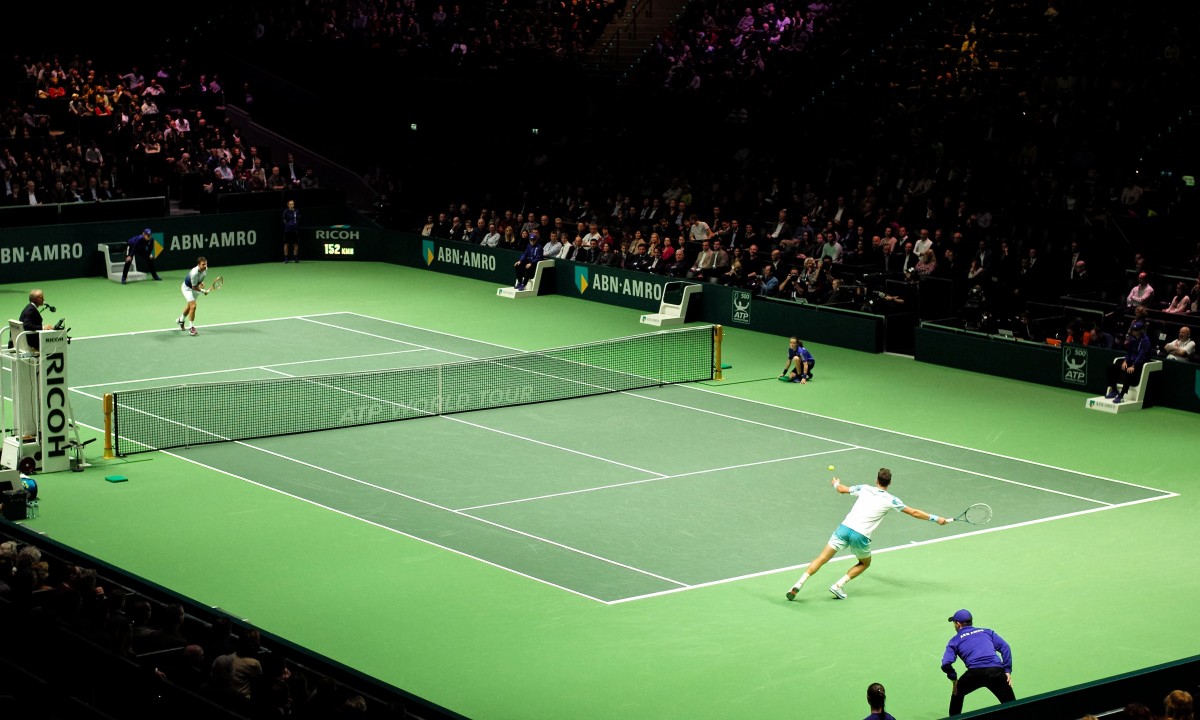
Indoor recreational and professional layouts can differ in how they distribute light across the court. The recreational example below illustrates a simpler sideline-oriented pattern. The professional example illustrates a denser grid of illuminated areas intended to support more demanding visibility and uniformity goals.


Example of indoor tennis court lighting layout (recreational on the left, professional on the right)

The images are layout illustrations. Their bright areas do not establish an exact fixture count, overhead mounting position, or measured foot-candle level. For an indoor project, the designer must account for ceiling height, structural mounting points, court orientation, and what players see when looking upward.

What Are Common Outdoor Tennis Court Pole Layouts?

Outdoor courts commonly use poles along both sidelines, with the number and spacing selected through photometric design. A four-pole arrangement may be evaluated for a recreational court. Six-pole arrangements, often with three positions along each side, give designers more locations from which to light the baselines and center of the court. Consider more poles when a facility has demanding performance requirements or difficult site conditions.

These are starting configurations, not rules tied to a level of play. More poles do not automatically produce better uniformity, and an eight-pole arrangement is not inherently required for a tournament. Fixture distribution, aiming, available setbacks, and neighboring courts determine whether any proposed layout performs as intended.

How tall should outdoor tennis court light poles be?

Approximately 20–30 feet is a useful preliminary height range for some outdoor tennis court projects, but it is not a universal specification. More demanding layouts or greater setbacks may call for different heights. Fixtures mounted too low may require aggressive aiming across the court; taller poles introduce their own structural and off-site considerations.

The photometric plan should test feasible pole heights together with fixture optics and setback distances. Pole bases must also remain outside player movement areas.


Bring Your Sports Lighting Design to Life

A successful tennis court lighting project requires the right combination of fixture selection, placement, light levels, uniformity, glare control, and system design. Whether you are upgrading existing courts or planning a new athletic lighting project, the right LED sports lighting solution can improve visibility and performance while supporting greater energy efficiency and long-term reliability.

Explore our LED Sports Lighting solutions to see how Stouch Lighting supports athletic fields, courts, and stadiums with lighting design and product expertise, then tell us about your project and let our team help you determine the right solution for your facility.

👉 Explore LED Sports Lighting for Athletic Fields & Stadiums

👉 Tell Us About Your Sports Lighting Project


How Do Fixture Optics Control Glare?

Fixture optics reduce tennis court glare by directing light onto the playing area while limiting direct views of the light source from player sightlines. Asymmetric or forward-throw distributions can send light across the court without relying on excessive upward tilt. Depending on the fixture and site, visors, louvers, or house-side shields can further block unwanted views of bright emitters.

Review the proposed aiming from both baselines and sidelines, particularly where a player looks during a serve or overhead shot. Assess a fixture’s cutoff performance in its installed, aimed position; a favorable product rating alone does not prove the finished layout will control glare.

How Can Outdoor Courts Prevent Light Spill?

Light spill is light reaching areas outside the intended court site. A design should report predicted readings at property lines and sensitive locations, while also checking whether neighbors will see the bright fixture faces directly.

Precise optics, shielding, pole placement, and aiming can help contain light. Controls should switch off unused courts and follow any required curfew. DarkSky International’s outdoor sports lighting criteria evaluate uplight, targeted lighting, glare, controls, and spectrum as parts of the installed design. Local ordinances may impose additional limits.

What Color Temperature and CRI Are Suitable for Tennis Court Lighting?

A CCT in the approximate range of 4000K–5700K is a practical range to evaluate for tennis court lighting, subject to the facility’s visual preferences and any applicable requirements. Correlated color temperature (CCT) describes whether white light appears warmer or cooler; it does not, by itself, determine ball visibility. Fixture consistency, contrast, glare, and light distribution also matter.

A specification may start with a color rendering index (CRI) of 80 or higher and then check whether video or event requirements call for more. CRI describes how faithfully colors appear under the light source.

For outdoor projects, do not assume that “DarkSky compliance” universally requires 3000K or lower. DarkSky International’s published outdoor sports lighting criteria allow a maximum CCT of 5700K, while encouraging lower CCTs when practicable. A local ordinance may set a stricter limit.

What Should a Photometric Study Show?

A photometric study should demonstrate that the proposed system meets its stated light-level, uniformity, glare, and spill targets before fixtures are purchased. It should identify:

Item to review

What the plan should show

Site geometry

Court lines, run-off boundaries, neighboring courts, and property lines

Equipment and layout

Fixture models, optics, mounting locations, heights, and aiming

On-court performance

Maintained horizontal and relevant vertical illuminance readings

Consistency

The calculation grid, minimum and average readings, and clearly labeled uniformity ratios

Off-site effects

Predicted spill readings and relevant glare views

After installation, measure court light levels and inspect glare and spill while the system is operating. Field verification gives the facility a chance to correct aiming issues that may not be obvious from a plan.

Frequently Asked Questions

Can existing tennis court poles be reused for an LED retrofit?

Yes, if an evaluation shows they suit the proposed system. Confirm the poles’ and foundations’ capacity for the new fixtures and brackets, including wind loading and effective projected area. Then verify that the existing heights and setbacks allow the LED optics to meet the lighting targets without excessive aiming. Don't assume an LED fixture is lighter or easier for every existing pole to support.

How many tennis court light fixtures are needed?

There is no reliable fixed number. The answer depends on fixture light distribution, mounting positions, court geometry, and performance targets. The indoor illustrations in this guide show example patterns, not required fixture counts.

Can one court use different lighting levels for practice and competition?

Yes. A controllable LED system can offer separate settings for different uses, as long as each setting delivers suitable visibility and uniformity. Outdoor operating schedules must also follow applicable local requirements.

Plan Your Tennis Court Lighting with Stouch Lighting

A successful system starts with the court’s intended use and a layout you can measure against clear performance targets. Stouch Lighting can help you evaluate LED sports lighting options and develop a fixture and supply plan based on your facility’s dimensions, mounting conditions, and surrounding properties.